
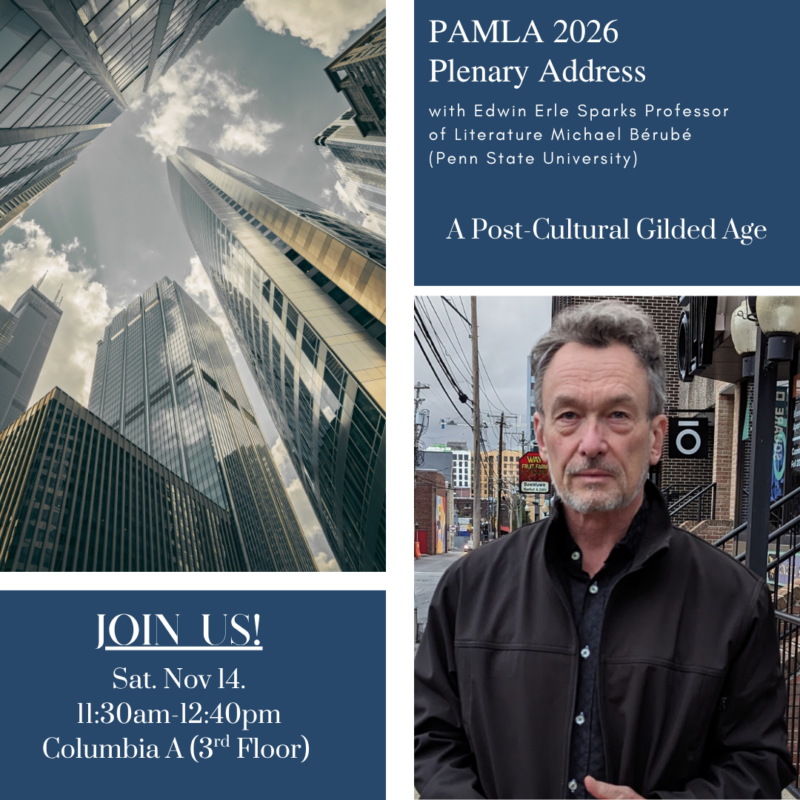
PAMLA is delighted to welcome Michael Bérubé, Edwin Erle Sparks Professor of Literature at Penn State University, as the featured plenary speaker for the 123rd Annual PAMLA Conference in Seattle.
In “A Post-Cultural Gilded Age,” Bérubé turns to the relationship between extraordinary wealth and cultural power in our own moment. Where the industrial fortunes of the original Gilded Age were accompanied by questions of cultural capital, social assimilation, and the establishment of museums, universities, concert halls, and foundations, Bérubé asks what happens when today’s technological and financial elites appear largely indifferent to those older forms of cultural legitimacy.
The address speaks directly to the PAMLA 2026 conference theme, “Our Ruling Classes: Culture, Power, Conflict,” while posing a larger challenge to how scholars have understood the relationship between economic power and cultural production for more than a century.
“A Post-Cultural Gilded Age”
Saturday, November 14, 2026
11:30 AM–12:40 PM
Columbia A (3rd Floor)
The literature of the Gilded Age in the United States stages the question of whether the industrialist nouveau riche can assimilate into the world of old money by accruing the cultural capital necessary for acceptance into “society.” This question, in turn, rests upon the consolidation of the terms “culture” and “society” over the course of the preceding century, as Raymond Williams’s work has shown us. What is striking about the current Gilded Age, Bérubé argues, is how utterly irrelevant this question has become: our new overlords could not care less about it. A corollary of the declining relevance of “culture” is the absence, among many of today’s most powerful tech entrepreneurs and financiers, of the older sense of philanthropic obligation to establish museums, concert halls, universities, or charitable foundations. There is, therefore, a profound disconnection between the world of tech billionaires and hedge-fund managers and the worlds of literature, film, and the arts. This separation poses a severe challenge to the base-superstructure model that has served as an anchor of cultural analysis for the past 150 years. If the ruling economic class no longer seeks cultural legitimation in the ways familiar from the first Gilded Age, how should we understand the relationship between culture and power in the twenty-first century?
Michael Bérubé is Edwin Erle Sparks Professor of Literature at Penn State University and one of the leading scholars and public intellectuals working at the intersections of literary studies, cultural politics, higher education, disability studies, and academic freedom. His most recent book, The Ex-Human: Science Fiction and the Fate of Our Species, was published by Columbia University Press in 2024. Examining works by writers including Ursula K. Le Guin, Margaret Atwood, Liu Cixin, Philip K. Dick, and Octavia Butler alongside films such as 2001: A Space Odyssey, Blade Runner, The Terminator, and The Matrix, Bérubé considers how science fiction imagines humanity from the vantage point of something other than the human—and what those imagined futures might tell us about the fate of our species. Bérubé is the author of numerous books, including Public Access: Literary Theory and American Cultural Politics; Life As We Know It: A Father, A Family, and an Exceptional Child; What’s Liberal About the Liberal Arts? Classroom Politics and “Bias” in Higher Education; The Secret Life of Stories: From Don Quixote to Harry Potter, How Understanding Intellectual Disability Transforms the Way We Read; and Life as Jamie Knows It: An Exceptional Child Grows Up. With Jennifer Ruth, he is the co-author of The Humanities, Higher Education, and Academic Freedom: Three Necessary Arguments and It’s Not Free Speech: Race, Democracy, and the Future of Academic Freedom. He has also edited or co-edited several volumes and, in 2021, edited the 1818 text of Mary Shelley’s Frankenstein for the Norton Library. Bérubé has held numerous leadership roles within the profession, including serving as President of the Modern Language Association, and has served on the executive bodies of the American Association of University Professors, contributing extensively to national conversations surrounding academic freedom, tenure, higher education, and the public humanities.
We hope you’ll join us in Seattle for Michael Bérubé’s PAMLA 2026 Plenary Address.